Comparing distributions
Review: density estimation
Smoothed densities are good for visualizing the shape of a distribution
There are two ways to produce smoothed densities:
Review: display full distribution with ECDF plots
Pros:
Displays all of the data (sorted)
Does NOT require any parameters to adjust
As \(n \rightarrow \infty\) , the ECDF \(\hat F_n(x)\) converges to\(F(x)\)
Cons:
|> ggplot (aes (x = flipper_len)) + stat_ecdf ()
Probability distributions
A distribution is a mathematical function \(f(x \mid \theta)\) where
\(x\) may take on continuous or discrete values over the domain (i.e. all possible inputs) of \(f(x \mid \theta)\) \(\theta\) is a set of parameters governing the shape of the distribution
e.g. \(\theta = \{\mu, \sigma ^2 \}\) for a normal/Gaussian distribution
the \(\mid\) symbol means that the shape of the distribution is conditional on the values of \(\theta\)
Let \(f\) denote the distribution for its
probability density function (PDF) if \(x\) is continuousprobability mass function (PMF) if \(x\) is discrete
Note:
\(f(x \mid \theta) \geq 0\) for all \(x\) \(\displaystyle \sum_x f(x \mid \theta) = 1\) (discrete case) or \(\displaystyle \int_x f(x \mid \theta) = 1\) (continuous case)
Example: Normal distribution
Given \(X \sim N(\mu, \sigma^2)\)
PDF: \(\displaystyle{f}(x \mid \mu, \sigma^2) = \frac{1}{\sigma\sqrt{2\pi}} \exp \left\{ -\frac{1}{2} \left(\frac{x-\mu}{\sigma}\right)^2 \right\}\) for \(x \in (- \infty, \infty)\)
Standard normal distribution: \(N(0, 1)\)
tibble (x = c (- 5 , 5 )) |> ggplot (aes (x)) + stat_function (fun = dnorm, color = "blue" ,args = list (mean = 0 , sd = 1 )) + stat_function (fun = dnorm, color = "red" ,args = list (mean = - 2 , sd = sqrt (0.5 )))
Distribution functions in R
Example: normal distribution
dnorm(): normal density function
pnorm(): normal cumulative distribution function (fraction of values smaller than)
qnorm(): normal quantile function (inverse of cumulative distribution)
rnorm(): generate normal random variables
Note: Replace “norm” with the name of another distribution, all the same functions apply
e.g., “t”, “exp”, “gamma”, “chisq”, “binom”, “pois”, “unif”, etc.
See this manual for more details
Parametric density estimation
Instead of trying to estimate the whole \(f(x)\) non-parametrically, assume a particular distribution \(f(x)\) and estimate its parameters
For example, assume \(X_i \sim N(\mu, \sigma^2)\) . Then use the observed data to estimate the parameters \[\hat{\mu} = \bar{x} = \frac{1}{n} \sum_{i=1}^n x_i \quad \text{and} \quad \hat{\sigma}^2 = \frac{1}{n-1} \sum_{i=1}^n (x_i - \bar{x})^2\]
The (plug-in) density estimate is \[\hat f(x) = \frac{1}{\hat\sigma\sqrt{2\pi}} \exp \left\{ -\frac{1}{2} \left(\frac{x-\hat\mu}{\hat\sigma}\right)^2 \right\}\]
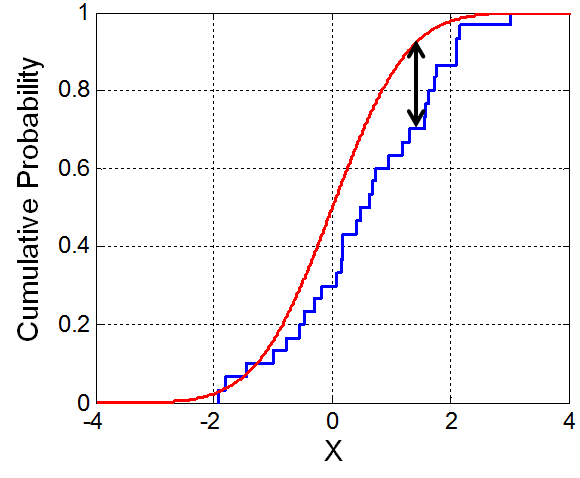
One-sample Kolmogorov-Smirnov test
Compare the ECDF \(\hat{F}(x)\) to the CDF \(F(x)\) of a theoretical distribution
Null hypothesis: the observed data follow a particular theoretical distribution
Test statistic: \(\displaystyle \quad \max_x |\hat{F}(x) - F(x)|\)
If \(\hat{F}(x)\) is far away from \(F(x)\) , reject the null hypothesis
One-sample Kolmogorov-Smirnov test example
What if we assume flipper_len follows Normal distribution? (i.e., \(H_0:\) flipper_len \(\sim N(\mu, \sigma^2)\) )
Need estimates for mean \(\mu\) and standard deviation \(\sigma\) :
<- mean (penguins$ flipper_len, na.rm = TRUE )<- sd (penguins$ flipper_len, na.rm = TRUE )
One-sample KS test: There is strong evidence that flipper_len is not normally distributed
ks.test (x = penguins$ flipper_len, y = "pnorm" , mean = fl_mean, sd = fl_sd)
Asymptotic one-sample Kolmogorov-Smirnov test
data: penguins$flipper_len
D = 0.12428, p-value = 5.163e-05
alternative hypothesis: two-sided
Visualizing empirical and parametric densities
|> ggplot (aes (x = flipper_len)) + geom_density (color = "blue" ) + stat_function (fun = dnorm, linetype = "dashed" , color = "black" ,args = list (mean = fl_mean, sd = fl_sd))
Visualizing empirical and parametric CDF
See Appendix for code
Comparing multiple empirical distributions
Goal: determine whether a quantitative variable depends on a categorical variable
Examples:
clinical trials with multiple treatments
assessing differences across race, gender, socioeconomic status, etc.
industrial experiments, A/B testing
Graphical comparison: overlayed densities, side-by-side violin plots, faceted histograms, etc.
Remember:
It’s useful to visualize and compare conditional distributions
But when are differences in a graphic statistically significant ?
We need formal statistical inference (e.g., hypothesis tests)
Example: Spotify songs duration by genre
Example: Spotify songs duration by genre
Do rap and rock songs differ in duration?
Two-sample Kolmogorov-Smirnov test
Use a two-sample KS to compare two empirical distributions \(\hat{F}_A(x)\) and \(\hat{F}_B\)
Null hypothesis: two samples \(A\) and \(B\) follow the same distribution
Test statistic: \(\displaystyle \quad \max_x |\hat{F}_A(x) - \hat{F}_B(x)|\)
If \(\hat F_A\) and \(\hat F_B\) are far away from each other, reject the null hypothesis
Two-sample Kolmogorov-Smirnov test example
<- read_csv ("https://raw.githubusercontent.com/rfordatascience/tidytuesday/master/data/2020/2020-01-21/spotify_songs.csv" ) |> mutate (duration = duration_ms / 60000 )<- spotify_songs |> filter (playlist_genre == "rap" ) |> pull (duration)<- spotify_songs |> filter (playlist_genre == "rock" ) |> pull (duration)ks.test (rap_duration, y = rock_duration)
Asymptotic two-sample Kolmogorov-Smirnov test
data: rap_duration and rock_duration
D = 0.22386, p-value < 2.2e-16
alternative hypothesis: two-sided
We have strong evidence that the duration distributions differ between rap and rock songs.
Statistical tests for comparing distributions
Note: unlike the KS test, difference in means and variances are sensitive to non-normality
Different distributions can yield insignificant results
What about the difference between pop and rap?
Comparison using full data
table (spotify_songs$ playlist_genre)
edm latin pop r&b rap rock
6043 5155 5507 5431 5746 4951
<- spotify_songs |> filter (playlist_genre == "rap" ) |> pull (duration)<- spotify_songs |> filter (playlist_genre == "pop" ) |> pull (duration)ks.test (rap_duration, y = pop_duration)
Asymptotic two-sample Kolmogorov-Smirnov test
data: rap_duration and pop_duration
D = 0.14569, p-value < 2.2e-16
alternative hypothesis: two-sided
There is a statistically significant difference in duration between rap and pop songs (given large sample size)
Comparison using a smaller subset of data
set.seed (2017 )<- spotify_songs |> group_by (playlist_genre) |> slice_sample (n = 100 )table (subset_songs$ playlist_genre)
edm latin pop r&b rap rock
100 100 100 100 100 100
<- subset_songs |> filter (playlist_genre == "rap" ) |> pull (duration)<- subset_songs |> filter (playlist_genre == "pop" ) |> pull (duration)ks.test (subset_rap_duration, y = subset_pop_duration)
Asymptotic two-sample Kolmogorov-Smirnov test
data: subset_rap_duration and subset_pop_duration
D = 0.16, p-value = 0.1545
alternative hypothesis: two-sided
There is NO statistically significant difference in duration between rap and pop songs
But it still looks different visually???
Test for difference in means
Using a two-sample \(t\) -test
Null hypothesis: the means of two groups (populations) are equal
t.test (subset_rap_duration, subset_pop_duration)
Welch Two Sample t-test
data: subset_rap_duration and subset_pop_duration
t = 0.83091, df = 172.78, p-value = 0.4072
alternative hypothesis: true difference in means is not equal to 0
95 percent confidence interval:
-0.1461026 0.3585440
sample estimates:
mean of x mean of y
3.694096 3.587875
Test for difference in variances
Using a Bartlett test
Null hypothesis: all variances are equal
bartlett.test (list (subset_rap_duration, subset_pop_duration))
Bartlett test of homogeneity of variances
data: list(subset_rap_duration, subset_pop_duration)
Bartlett's K-squared = 15.54, df = 1, p-value = 8.08e-05
Rejects at \(\alpha = 0.05\) even with this smaller sample size!
Why did the KS test reveals no differences while the graphs are clearly different? Two possible reasons:
Statistical power
Statistical power is key to really understanding graphics: whether we’re seeing real effects versus noise
Remember: Type 1 error is falsely rejecting; Type 2 error is falsely failing to reject
Toy example: power of a \(t\) -test
Consider two samples \(\mathbf{X} = (X_1,\dots,X_n) \sim N(0, 1)\) and \(\mathbf{Y} = (Y_1,\dots,Y_n) \sim N(\delta, 1)\)
Use a \(t\) -test for difference in means between \(\mathbf{X}\) and \(\mathbf{Y}\)
Simulate \(\mathbf{X}\) and \(\mathbf{Y}\) 1000 times for some \(n\) and \(\delta > 0\)
Count the number of rejections
\[
\begin{aligned}
\textsf{power}
&= P(p\text{-value} \leq \alpha \mid H_0 \text{ is false}) \\
&= P(p\text{-value} \leq \alpha \mid \delta > 0) \\
&\approx \frac{\text{# rejections}}{1000}
\end{aligned}
\]
Consider \(n = 10, 20, \dots, 1000\) and \(\delta = 0.1\) or \(\delta = 0.25\)
Toy example: power of a \(t\) -test
Another toy example: power for different tests
Consider two samples: \(\mathbf{X} = (X_1,\dots,X_n) \sim N(0, 1)\) and \(\mathbf{Y} = (Y_1,\dots,Y_n) \sim N(0, 1.5)\)
Consider three ways to test differences between \(\mathbf{X}\) and \(\mathbf{Y}\)
\(t\) -test
Bartlett test
KS test
Simulate \(\mathbf{X}\) and \(\mathbf{Y}\) 1000 times for samples sizes \(n = 10, 20, \dots, 1000\)
What do you think the power curves will look like for these methods?
Another toy example: power for different tests
Takeaways
Graphics should be paired with statistical analyses to determine if a true effect versus noise is displayed
Even if there is a true effect, there may be limited power to detect it
Remember: Power is the probability of rejecting when the null is false
Things that increase statistical power: